
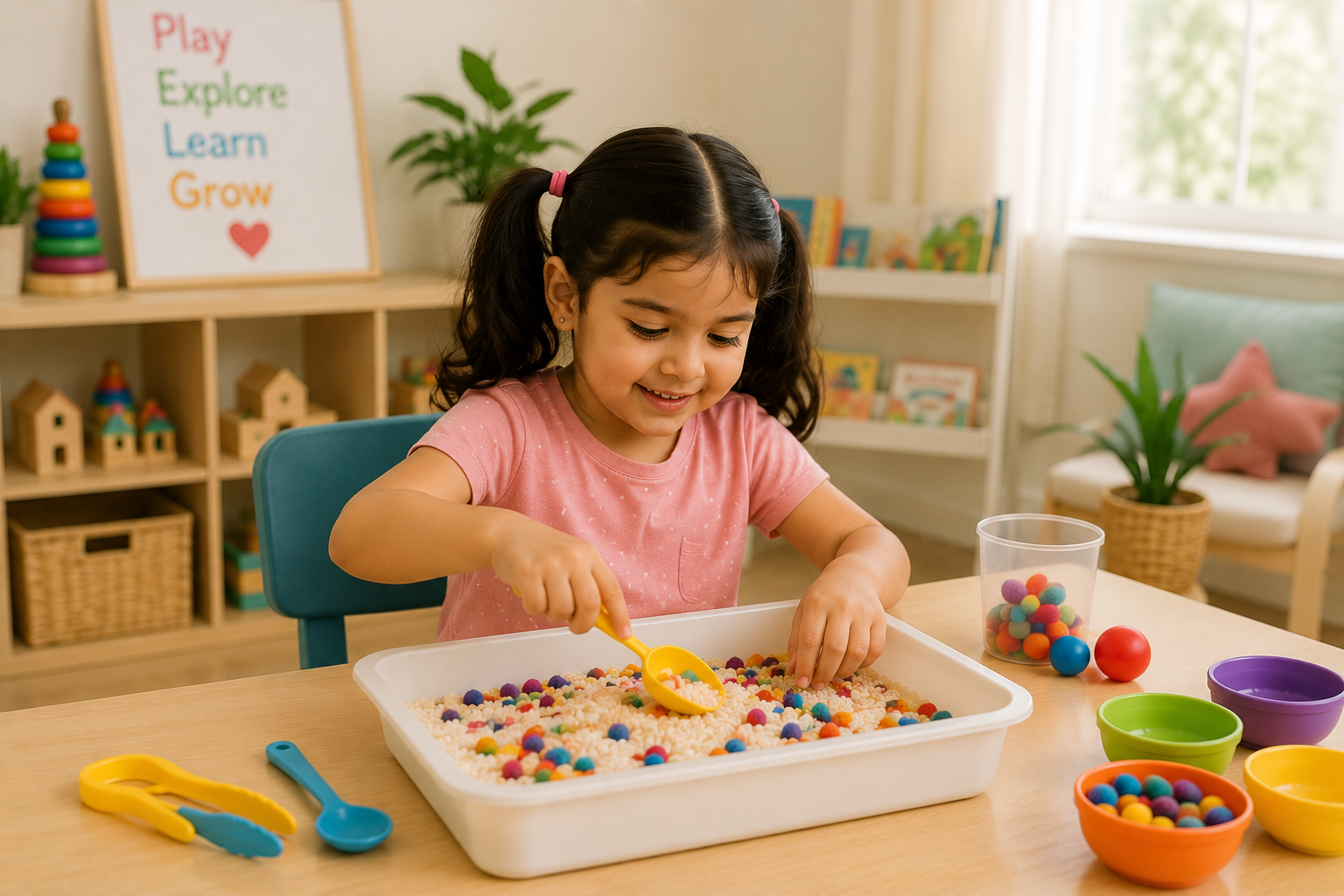
Children experience sound, touch, movement, light, taste, smell and internal body signals in different ways.
A sensory preference is not automatically a problem. It may be worth exploring when a child’s response to
sensory information repeatedly affects dressing, eating, learning, play, sleep, community activities or family routines.
What Is Sensory Processing?
Sensory processing describes how the brain and body receive, organise and respond to information from the senses.
This happens throughout the day: while getting dressed, eating breakfast, walking into a busy classroom, playing
outdoors or settling for sleep.
Everybody has sensory preferences. One person may enjoy strong flavours, another may prefer mild food. One child
may concentrate better in a quiet room, while another may seek movement before sitting at a table. Differences
become more important when they consistently interfere with activities the child needs or wants to do.
NHS occupational therapy guidance similarly distinguishes sensory differences from difficulties that limit
meaningful participation. It advises looking at the effect on everyday function rather than assuming that every
preference requires therapy.
Read the Leeds Community Healthcare sensory-differences guidance.
This is why an occupational therapy discussion usually begins with practical questions:
Which activity is difficult? Where does it happen? What does the child do? What makes the situation easier or harder?
The Eight Sensory Systems
Sensory processing is commonly discussed across eight systems:
- Visual: information received through sight, including light, colour, movement and visual clutter.
- Auditory: information received through sound, including volume, pitch and unexpected noise.
- Tactile: touch information from the skin, such as clothing texture, water, grooming and messy play.
- Gustatory: information related to taste.
- Olfactory: information related to smell.
- Vestibular: information related to movement, balance and changes in head position.
- Proprioceptive: information from muscles and joints that contributes to body awareness and force control.
- Interoceptive: information from inside the body, such as hunger, thirst, temperature, tiredness or the need to use the toilet.
West Suffolk NHS Foundation Trust also describes these eight systems and explains that sensory strategies should
focus on managing needs through environmental adaptation, task modification and self-management support.
Read the West Suffolk NHS sensory-processing guidance.
Sensory Seeking and Sensory Avoiding
Children do not always respond in one fixed way. The same child may seek certain sensations and avoid others.
Responses may also change according to tiredness, hunger, illness, stress, familiarity and the demands of the environment.
Sensory-seeking responses may include
- Frequent jumping, climbing, spinning or crashing into cushions
- Touching objects or people repeatedly
- Chewing clothing, pencils or other non-food items
- Using excessive force with toys, pencils or doors
- Preferring strong flavours, loud sounds or intense movement
- Finding it difficult to remain seated during some activities
Sensory-avoiding or sensitive responses may include
- Covering the ears around common or unexpected sounds
- Avoiding crowded rooms, assemblies, parties or busy shops
- Resisting clothing seams, labels or particular fabrics
- Becoming distressed during hair washing, nail cutting or toothbrushing
- Avoiding messy play or certain food textures
- Disliking swings, escalators, climbing or movement activities
These examples are observations, not a diagnosis. A behaviour may have several possible explanations, including
communication, pain, anxiety, attention, motor demands, learning needs, sleep, hearing, vision or the environment.
The pattern and its impact on participation matter more than an isolated behaviour.
How Sensory Differences May Affect Everyday Activities
Dressing and grooming
A child may object to seams, labels, tight waistbands, water on the face, hair brushing or the sound of clippers.
The routine may take much longer than expected or lead to repeated distress.
Eating and mealtimes
A child may prefer a narrow range of textures, temperatures, smells or flavours. Mealtime difficulty can also involve
oral-motor, swallowing, gastrointestinal, medical, developmental or behavioural factors. Persistent feeding concerns
should therefore be discussed with an appropriately qualified professional rather than being assumed to be sensory.
School participation
Noise, visual clutter, touch from nearby pupils, movement demands or the effort required to sit still may affect
concentration and participation. The child may cope in one classroom but struggle in another because the environments
are different.
Play and community activities
Playgrounds, birthday parties, shopping centres and family events can combine movement, noise, light, smell and
unpredictable touch. A child may leave early, avoid joining in or require more preparation and recovery time.
Sleep and transitions
Changes in activity, clothing, lighting, sound and body state may make transitions harder. Sensory factors may be one
part of the picture, but sleep routines, health, anxiety and environmental expectations should also be considered.
For a broader overview of functional concerns, read
Early Signs Your Child May Benefit From Occupational Therapy.
Observe Patterns Rather Than Labelling Behaviour
Brief notes can help parents and professionals understand what is happening. Record observations for one or two weeks,
focusing on situations rather than labels.
For each difficult activity, note:
- Activity: What was the child expected to do?
- Environment: Where did it happen? Was it noisy, crowded, bright, unfamiliar or rushed?
- Response: What did the child say or do?
- Duration: How long did the response continue?
- Support: What did adults try?
- Outcome: What appeared to help, and was the child able to return to the activity?
Look for repeated patterns. For example, “refuses to cooperate” is a judgement, while “covers ears and leaves the room
when the hand dryer starts” is a specific observation that is easier to discuss and address.
Practical Ways to Support Participation
Strategies should be individual, proportionate and linked to a meaningful activity. A method that helps one child may
be uncomfortable, distracting or unsafe for another.
1. Change one factor at a time
Reduce background noise, adjust lighting, remove an irritating clothing label or allow extra preparation time.
Changing one factor makes it easier to observe whether the adjustment is useful.
2. Make routines predictable
Use simple verbal warnings, pictures or a consistent sequence before grooming, transitions or community outings.
Predictability may reduce uncertainty even when the sensory experience itself cannot be removed.
3. Offer reasonable choices
Choices can preserve participation without forcing a single method. A child might choose between two suitable shirts,
use a quieter toilet or complete grooming steps in a preferred order.
4. Support communication
Help the child describe sensations in neutral language such as “too loud”, “scratchy”, “I need space” or “I need a break”.
Communication methods should match the child’s developmental and language needs.
5. Protect safety and dignity
Do not force a child into intense sensory experiences or use equipment without considering safety, supervision and
suitability. General online lists are not a substitute for an individual assessment.
6. Review whether the strategy supports the actual activity
The goal is participation, not simply performing a sensory exercise. Ask whether the adjustment helps the child dress,
learn, play, eat, travel or complete another meaningful routine.
NELFT NHS resources similarly encourage families to examine everyday tasks, try appropriate strategies and monitor
what changes.
Explore NELFT’s sensory-processing resources.
When May Professional Guidance Be Helpful?
Consider speaking with a paediatrician, occupational therapist or another relevant professional when:
- Sensory responses repeatedly prevent participation in dressing, eating, school, play or community activities
- The child regularly experiences significant distress
- Difficulties are increasing or occur across several settings
- Family routines are becoming difficult to maintain
- School staff report similar concerns
- There are associated movement, feeding, communication, sleep or developmental concerns
- The child has lost a skill they previously used
- Parents are unsure whether another health or developmental issue should be considered
An occupational therapist may explore the child’s daily activities, the environment, task demands, strengths and
family priorities. Recommendations may involve caregiver guidance, environmental adjustments, changes to task demands,
skill development, school collaboration or referral to another professional.
Learn more about
Pediatric Occupational Therapy,
arrange a Parent Consultation,
or review the Knowledge Centre.
Is “Sensory Processing Disorder” a Diagnosis?
Parents may encounter the term “Sensory Processing Disorder” online. West Suffolk NHS guidance notes that it is not
included as a standalone diagnosis in the DSM-5 and recommends describing sensory processing differences rather than
using the label as a diagnosis.
This does not mean a child’s experiences are unimportant. It means assessment should focus on the child’s functional
difficulties, participation, development and any recognised medical or developmental conditions that may also be relevant.
Frequently Asked Questions
Does every sensory preference require occupational therapy?
No. Sensory preferences are common. Professional guidance may be worth considering when the response repeatedly affects
safety, independence, learning, play, self-care or family participation.
Can a checklist diagnose my child?
No. A checklist may help organise observations, but it cannot determine the cause of a child’s difficulties or replace
an individual professional assessment.
Should parents create a “sensory diet” from online advice?
A generic programme may not be suitable for every child. Strategies should be connected to the child’s activities,
preferences, abilities and safety needs. Seek individual guidance before using specialised equipment or intensive activities.
Can sensory concerns be discussed online?
Some concerns may be explored through caregiver discussion, observation of home routines and practical coaching.
Suitability depends on the child’s needs and whether in-person assessment is required. Read about
Online Therapy.
Can I contact the centre without a diagnosis?
Yes. Parents can describe the activities that are difficult and the impact on family life. An initial discussion can
help identify whether occupational therapy guidance or another pathway may be appropriate.
Discuss Your Child’s Everyday Sensory Challenges
When sound, touch, movement, grooming, mealtimes or busy environments repeatedly affect your child’s participation,
a parent consultation can help organise your observations and identify appropriate next steps.
Book a Parent Consultation
|
Contact Blessings Therapy Centre
|
Read Frequently Asked Questions
Medical Information Disclaimer
This article provides general educational information. It does not diagnose a condition, prescribe an individual
sensory programme or replace medical, developmental, feeding, psychological or occupational therapy assessment.
Seek advice from an appropriately qualified healthcare professional regarding concerns about your child. For urgent
symptoms or a medical emergency, seek immediate medical care.
Read the full Medical Disclaimer.
Sources and Further Reading
-
Leeds Community Healthcare NHS Trust — Sensory Differences
-
West Suffolk NHS Foundation Trust — Occupational Therapy for Children Who Have Sensory Processing Differences
-
NELFT NHS Foundation Trust — Understanding Sensory Processing
-
Black Country Children’s NHS Services — Sensory Differences Information